
Given the stronger rural activity, and potential goods and services tax (GST) impact, investors are bullish on the two-wheeler (2W) segment. In August, dealers in the domestic market picked up 11 per cent more 2Ws year-on-year (Y-o-Y), despite only 2 per cent growth in retail registrations. This indicates inventory stocking ahead of the festival season. Export trends were good. TVS Motor and Royal Enfield may have gained domestic market share.

All sectoral indices ended lower. BSE Telecommunication tanked 2.18 per cent, metal (1.77 per cent), auto (1.70 per cent), energy (1.64 per cent), oil & gas (1.59 per cent), commodities (1.39 per cent) and financial services (1.37 per cent) were the major laggards.

In trade negotiations, as in chess, sometimes you need to accept a temporary disadvantage to secure a better long-term position, points out Sonal Varma, chief economist (India and Asia ex-Japan) at Nomura.

The rupee has held its ground against the US dollar in the 2025 calendar year so far, but depreciated significantly against the euro and pound. It fell by 6.83 per cent, and 5.44 per cent against the euro and pound respectively, as the two currencies strengthened significantly against the greenback during the period.

Vehicles are depreciating assets and lose their value over time.

Raising overseas debt has become prohibitively expensive due to the depreciating rupee.

From the 30-share blue-chip pack, Tata Steel, NTPC, Kotak Mahindra Bank, IndusInd Bank, Power Grid, Zomato, Adani Ports, Asian Paints, Mahindra & Mahindra and Reliance Industries were among the biggest laggards. Titan and Sun Pharma were the only gainers.

In response to the panic triggered by Trump's trade policies, the RBI net sold approximately $43 billion in the second half of FY25 to curb volatility, as the rupee plunged to a low of 87.95 per dollar in February this year.

Engineering and construction major Larsen & Toubro (L&T) reported a 25 per cent rise in net profit attributable to the owners of the company for the January-March quarter of 2024-25, owing to higher revenues and an exceptional gain. For the quarter under review, L&T posted a consolidated net profit of Rs 5,497.3 crore, while revenue rose 10.9 per cent year-on-year (Y-o-Y) to Rs 74,392.28 crore.
Mukesh Ambani-led Reliance Industries Ltd (RIL) plans to invest Rs 75,000 crore ($9 billion) each into its new energy business and petrochemical expansion, according to a company presentation. In its FY25 result statement, Ambani said the company has laid a strong foundation for its projects in renewable energy and battery operations. "In the coming quarters, we will see the transition of this business from incubation to operationalisation.

Titan, Nestle, Hindustan Unilever, State Bank of India, Larsen & Toubro, ITC, Zomato and Bajaj Finserv were also among the laggards. Adani Ports, IndusInd Bank, Tata Motors and HDFC Bank were among the major gainers.
'Of the 20 trading days of January till January 28, FIIs have been selling for 19 trading days'. 'When did FIIs withdraw money with this kind of intensity?' 'It never happened. It's the first. It did not happen even during the 2008-2009 financial crisis when Lehman went under.' 'Even then you did not have like a 19-day selling spree from the FIIs.'

Equity benchmark Sensex declined over 410 points to close below the 61,000-mark on Thursday, tracking weakness in M&M, Bajaj Finserv and Reliance Industries amid widespread selling pressure in global markets. A depreciating rupee also put pressure on domestic equities, traders said. In a subdued session, the 30-share BSE Sensex ended 419.85 points or 0.69 per cent lower at 60,613.70.

'Consider 40% to 50% in equities, 10% in gold as a hedge, and the remaining 30% to 40% split between multi-asset funds and hybrid funds.'
Equity benchmark index Sensex buckled under selling pressure for the second straight session to close below the 65k mark on Friday, as investors offloaded IT, teck and metal stocks amid a bearish global trend. Besides, fresh foreign fund outflows also hit investor sentiments, traders said. In a volatile trade, the 30-share BSE Sensex declined 202.36 points or 0.31 per cent to settle at 64,948.66.

Steel maker JSW Steel's Q3 results, announced on January 24, 2025, after market hours, failed to meet Street expectations. The company reported a consolidated net profit attributable to the owners of Rs 717 crore in Q3FY25, reflecting a 70.3 per cent decline Y-o-Y, compared to Rs 2,415 crore in Q3FY24.

PVR Inox shares hit a 44-month low of Rs 1,154, declining 8 per cent on the BSE in Tuesday's intra-day trade in an otherwise firm market, driven by growth concerns. The stock has slipped 23 per cent from its December high of Rs 1,620, touched on December 5, 2024. It has fallen below its previous low of Rs 1,203.7 from June 4, 2024, and is trading at its lowest level since May 2021.

India's most valued company, Reliance Industries Ltd (RIL), reported a robust performance in the third quarter of the current financial year (Q3FY25), surpassing analyst expectations. This coupled with positive commentary by brokerages led to the stock of the oil-to-telecom conglomerate surging as much as 4.44 per cent to hit an intraday high of Rs 1,325.1. It settled at Rs 1,301.3 apiece, up 2.57 per cent.

Apart from the emotional value attached to buying gold, the yellow metal offers protection against inflation, interest rate spikes, currency and geopolitical risks, says Anamika Pareek.

The rupee depreciated 44 paise and slipped below the 81-mark against the US dollar for the first time in early trade on Friday, weighed down by the strong american currency and risk-off sentiment among investors. Forex traders said escalation of geopolitical risk in Ukraine and rate hikes by the US Fed and Bank of England in a bid to contain inflation sapped risk appetite. Further, the strength of the American currency in the overseas market, a negative trend in domestic equities, and risk-off moods amid escalation of geopolitical risk in Ukraine weighed on the local unit.

The seasonally adjusted IHS Markit India Manufacturing Purchasing Managers' Index (PMI) fell from 58.9 in October to a three-month low of 56.3 in November, indicating that the manufacturing sector growth remained strong, despite losing traction.

Analysts are expecting pharmaceutical companies to post sales growth of 10-11 per cent in the second quarter this financial year while the Ebitda (earnings before interest, tax, depreciation, and amortisation) margins are anticipated to improve by about 110 basis points. Ebitda improvement will be led by lower input costs because prices of active pharmaceutical ingredients (APIs) are 5-15 per cent lower year-on-year (Y-o-Y). Axis Capital said sales growth would be around 10 per cent, of which growth in the India market would be 11 per cent or so.
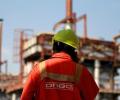
Upstream majors ONGC and Oil India (OIL) results for the January-March quarter (Q4) of FY24 suggest better production in future. But OIL missed its own production targets although it delivered higher volumes and it disappointed the market in terms of Ebitda. ONGC reported standalone Ebitda of Rs 17,400 crore (up 7 per cent year-on-year or Y-o-Y) in Q4FY24, slightly below estimates due to other higher expenses.

Coal India's (CIL's) revenue for the first quarter of 2024-25 (Q1FY25) came in at Rs 36,500 crore, up 1 per cent year-on-year (Y-o-Y) and down 3 per cent sequentially, which was in line with consensus. The blended average selling price was Rs 1,687/tonne, down 5 per cent Y-o-Y and down 1 per cent Q-o-Q, which was below estimates. The adjusted operating profit (excluding overburden removal or OBR costs) stood at Rs 11,500 crore up 3 per cent Y-o-Y and up 17 per cent Q-o-Q, which beat the street. This was due to lower operating expenses.

Vodafone Idea's (Vi's) subscriber loss reduced to a seven-month low in March, and alongside the company added 1.1 million broadband users after two months of net loss -- two things analysts have noted as key trends that need to be monitored. While Vi has been losing customers for more than two and a half years now, the churn reduced to below a million after five straight months in March, the Telecom Regulatory Authority of India (Trai) data has shown. "Jio's softer than usual subscriber growth in March, and VIL's slowing subscriber market share loss are key trends to keep an eye on going forward," global investment banking and financial services major UBS said in an analyst note.

After an extremely stable 2023, the Indian rupee started 2024 on a promising note and has turned out to be the best-performing Asian currency so far in January, appreciating 0.1 per cent despite 2 per cent rise in the dollar index. All other Asian currencies depreciated by around 1.4-4 per cent during the month. The local currency regained its ground against the greenback on the back of foreign portfolio inflows, said market participants.

Among the 30 Sensex companies, Larsen & Toubro, Power Grid, NTPC, State Bank of India, Reliance Industries and HDFC Bank were the biggest laggards. Sun Pharma and Nestle were the only gainers.

Sun Pharmaceutical Industries reported a 34 per cent year-on-year (Y-o-Y) jump in net profit to Rs 2,654.6 crore in Q4FY24.

Mondelez, Coca-Cola, PepsiCo and Nestle India have been working on bringing down the sugar, salt, and sodium content.

Investors shunned shares of oil marketing companies (OMCs) on Friday as they feared that the government's decision to cut retail prices of petrol and diesel could hurt the companies' profit margins in the near term. On Thursday, the government announced that OMCs will reduce pump prices of petrol and diesel after a record 22 months, making them cheaper by Rs 2 per litre in the national capital. The changes were effective from Friday.

Top losers in the Sensex pack included Tata Steel, Vedanta, Maruti, SBI, Coal India, Tata Motors, Sun Pharma, HUL, RIL, IndusInd Bank, Axis Bank, HDFC duo, ICICI Bank, M&M, Kotak Bank, and Infosys, falling up to 2.89 per cent.

Sensex has lost 1,623.43 points or 9.24 per cent in the eight sessions straight.

Maruti was the top loser in the Sensex pack, shedding around 3 per cent, followed by L&T, IndusInd Bank, Axis Bank, ONGC, Reliance Industries, Asian Paints and HDFC. On the other hand, HCL Tech, TCS, Sun Pharma and Tech Mahindra were among the gainers.

Shares of Mukesh Ambani-owned Reliance Industries Limited (RIL) rose nearly 1 per cent on Tuesday, hitting an intraday high of Rs 2,986.05 per share, after most brokerages reacted positively to the company's March quarter (Q4FY24) results. The bullish outlook stems from Reliance Jio's potential tariff hikes, given the competitive landscape, along with slow but steady improvement in the oil-to-chemical (O2C) vertical.

The Reserve Bank on Thursday tightened norms for consumer credit as it asked banks and NBFCs to assign a higher risk weight for unsecured personal loans, a move aimed at making the lenders more cautious on such advances. The risk weight on unsecured consumer loans has been raised by 25 percentage points. The new regulations, however, will not be applicable on housing loans, education loans, vehicle loans and loans secured by gold and gold jewellery, the Reserve Bank said in a circular.

Tata Power saw a big sell-off, with the stock falling almost 8 per cent after declaring disappointing results for the October-December quarter (Q3) of 2023-24 (FY24) on Friday evening. The company reported net consolidated revenue of Rs 14,650 crore, up 4.4 per cent year-on-year (Y-o-Y), and earnings before interest, tax, depreciation, and amortisation (Ebitda) of Rs 2,607 crore, up 2 per cent Y-o-Y, in the quarter, led by higher sales across Odisha distribution companies (discoms) and capacity addition in renewables. This was well below consensus estimates.

UltraTech Cement's third quarter of financial year 2023-24 (Q3FY24) performance saw a combination of 6 per cent year-on-year (Y-o-Y) volume growth and 8 per cent revenue growth coupled with better realisations per tonne. The earnings before interest, taxes, depreciation, and amortisation (Ebitda) stood at Rs 3,250 crore and Ebitda per tonne was Rs 1,191. Profit after tax (PAT) was reported at Rs 1,780 crore. Other income dipped and interest costs rose.

Brokerages have maintained their ratings and target prices on FSN E-Commerce Ventures, the parent company of Nykaa, after the fashion and beauty online retailer posted in-line numbers during the October-December quarter (Q3) of financial year 2023-24 (FY24). They have, however, cut earnings before interest, tax, depreciation, and amortisation (Ebitda) estimates after weak demand weighed across line items in Q3. "While revenue growth was healthy at 22 per cent year-on-year (Y-o-Y), gross margins declined 90 basis points (bps), weighed by higher discounting in own brands and lower ad income.

ICICI Bank was the top loser in the Sensex pack, shedding around 2 per cent, followed by Bharti Airtel, Axis Bank, Kotak Bank and PowerGrid. NSE Nifty closed 7.55 points or 0.07 per cent down at 11,527.45.

Fast moving consumer goods (FMCG) companies are expected to see muted topline growth, with uneven spread of the monsoon impacting demand. Rural demand recovery, too, remains elusive in the July-September quarter. Brokerages expect volumes to remain steady in the quarter on a sequential basis.
 © 2026 Rediff.com - Advertise with us - Disclaimer - Privacy Policy - Sitemap - Feedback - About us - Terms of use - Grievances